Note
This is an observational post that will likely be outdated in the next few months as technology continues to rapidly advance :).
Over the last year, AI coding evolved into a fundamentally new way of developing. Everyone has a powerful flow for planning, executing, and perfecting every stage in between, built around harnesses like Claude Code, Codex, Gemini CLI (or whatever iteration we are on now), and OpenCode, or (insert 50 thousand products here). Of course, people have been rolling their own harnesses from scratch or using tools like LangChain and LangGraph for a while now. But I think the primary use case has been to home in on integrating with one particular workflow or one particular platform, providing human intelligence on top of a deterministic flow. And outside the AI labs, where agents apparently already run the world (granted, with proofs of the Riemann Hypothesis and of an Ω(n9/4) lower bound for matrix multiplication, maybe they do), most of us are still living in "human-driving-agent" flows.
The challenge we have all felt, even as we level up to focus on architecture and business needs, is upleveling productivity without paying for it in context-switching, technical debt, and "LLM drudgery". Every tab takes time away from deep work and from working closely with colleagues, when that is ultimately what we want to be doing! With everyone trying to do everything, it feels like the brain is spinning up a process for every tab and OOMkilling on each, and we end up busier than ever while telling ourselves we've "moved to a higher level of the stack."
The shift that I am interested in seeing is moving from agents as coding harnesses/AI-integrated platforms (humans driving many wheels) towards agent pseudoautonomy (don't we call them agents for a reason?).
Toward Autonomous Flows
When I say autonomous I don't mean it takes actions without any human involvement at all. What I mean is more akin to running specific agent workflows on a cron job with the ability for the user to approve actions — sort of like having daemon harnesses with a specific "flavor" of what that agent needs to do.
This is the vision many of us have for these tools, especially for developer productivity as we integrate agents into our tooling and build truly agentic infrastructure. Ideal developer platforms not only facilitate the flows engineers are used to doing on a daily basis, but they also multiply the effectiveness of their time and expertise. So why not make them even more powerful and rich? I think this exists in some niche domains today, but it is far less common than the coding harnesses we all know well.
The closest thing I've seen to this is the individual harnesses teams have built to hyper-solve for a specific problem and integrate into a platform, such as Glean agents that provide support for a particular platform. Nobody drives them, and with decent context and evals, they are surprisingly smart!
But the step I find more interesting is chaining. Noticing an issue independently and then, with high accuracy and speed, working out why and proposing a config update for a human to approve.
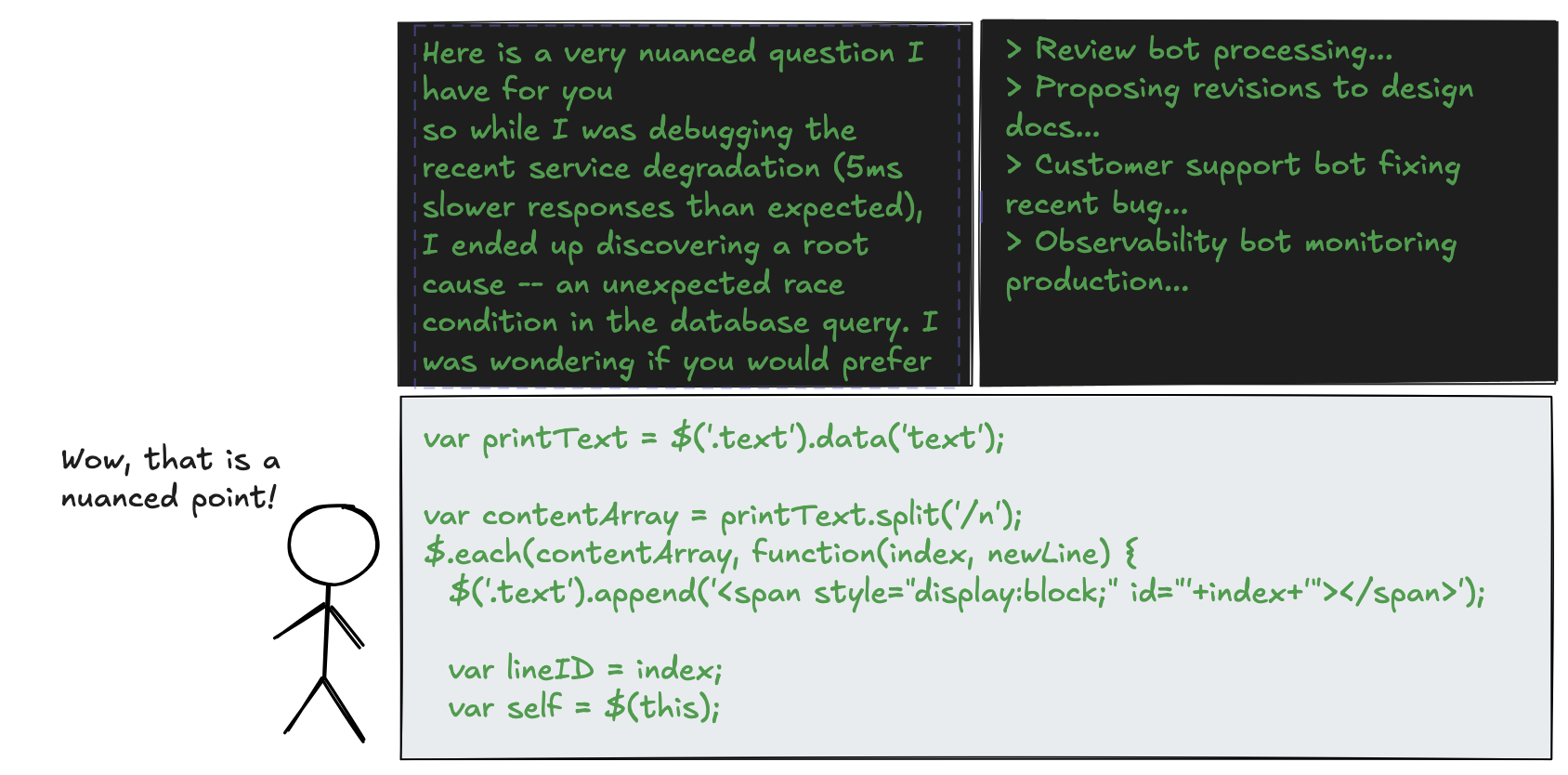
Less context switching (note: code still existing is intentional)
Today's coding harnesses are a sort of "least common denominator" of task execution. But what if you had background agents triaging support requests, reviewing code, and monitoring your observability stack, taking end-to-end flows all the way to completion with occasional interrupts for guidance? What if you could have it constantly self-learn and do a better job of triaging incidents more intelligently over the days and months that you use it?
Individual startups promise these capabilities, selling agents that can do these things in order to sell their product or collect data on your usage. And I think some teams have made a lot of progress in this direction with well-designed harnesses and evals. In aggregate, though, I think most end-to-end agentic engineering flows are still initiated and controlled by humans, introducing a significant "everything doing everything" context-switch problem.
Going in this Direction
As has been drilled into us in the last few years, agents work best in environments built for them: structured data (schemas in APIs, MCPs), fast ways to act (skills, CLIs), and instructions that enshrine actionable goals.
The foundation models will keep evolving, but structuring environments for agents makes those models perform more effectively (especially the low-cost, fast ones!) and makes the same environment easier for humans to reason about.
Humans Instructing, Agents Driving
In the hands-on model, attention is the thing agents consume. You are multiplexing your brain against a sea of terminal windows. In an autonomous flow, attention becomes something we spend deliberately, on the few moments that actually need human expertise, design, creativity, and passion.
That changes what "instructing" means. Instead of prompting turn by turn, we write down the goals, constraints, and "flavor" once, and let the agent run against them. We get intelligent outcomes and have fewer LLM-isms to trudge through (verbose code, poorly understood intentions, and severely non-deterministic actions).
As tokens get cheaper and harnesses improve, I think we will move from "humans with hands on 5 wheels, instructing agents" to "agents driving 5 wheels, humans instructing." Doing our life's work probably doesn't mean simply controlling more steering wheels. By making fewer decisions that matter more, we can focus on deep work, collaboration, and empowering our end users with the same capabilities!